Media: we don't always notice it, but it's always there. We're exposed to thousands of messages every day: that number will only grow as time goes on. The only change we can make is how we choose to look at it. By becoming more literate in media, advertising, and marketing, I have been able to look at all of these messages in a new light. I can now see that the huge amount of media we are exposed to in our lives can really affect us. Media has worked its way into my life so that my mind has been influenced by all the messages I absorb. It can make me want to buy new products, change my opinions and attitudes, or even change what I think to be valuable or factual in the world. With so many people trying to win over my mind, it's no surprise that the way I think is a product of many media messages (among other things, of course). Being aware of how these messages are affecting me is really the best attribute I can have when facing them. I can now apply my traits of meta-cognition and skepticism to these many ideas so I realize that I am being influenced and that I should doubt most of the media I am absorbing.For example, if I see an ad online that drills into my brain that Google Chrome is the best internet browser, I can take a step back and realize that it is not my own belief, but the force of advertising that is making me think that way. I can then think for myself, free of influence, and decide that I prefer Firefox.
Because of my recent education on the matter, I would say that my habits have changed to favor a more reserved absorption of media. I consume a bit less, and at a much slower rate. I now try to make myself aware of every constructed message out there, so I do not fall into making assumptions. In short, I don't believe everything I hear anymore. This is primarily a result of my improved media literacy. Literacy in media is extremely important - you have to know what you're seeing in order to realize that it's deceiving. Advertising techniques, emotional appeals...all are important concepts to grasp that offer insight to the tactics of advertisers and brands. If you don't understand the Gestalt principle, all you see are bright colors and confusing images; in fact, you are seeing the whole of the message, which influences you into becoming curious about the product (or whatever is being advertised). If you have this so-called media literacy, you will not fall prey to all of these techniques. In time, you will even become an educated consumer. People with knowledge of their consumption take media literacy one step further. They are also aware of how marketing works, and how advertisers sometimes try to transfer ideas into your brain through subconscious appeals, cross-promotion, and branding. Being an educated consumer gives you the useful tool of media skepticism: you will not fall for traps that cause you to buy products. This can save you a considerable amount of money that you would have spent on a product you didn't need but thought you needed because of deceptive advertising. It can also save you from forfeiting your own views and values for the way the marketers want you to think. A world full of people educated against their own consumerism is a world of unique people with unique ideas and views. I believe it is a better place.
Keeping the blog was an interesting experience. I got to share my views on media messages, while also sharing what I have learned throughout the semester. The best part was the freedom I had in doing so. It was rewarding to be able to comment on things that interested me, effectively applying my knowledge to my life. It was also an opportunity to see what other people had to think on the same issues, issues I had noticed, or even issues I had never heard of. My lifestyle (e.g. the television channels I watch, the mode of transportation I take) affects the media I am exposed to; only through others can I see a wide range of media messages aimed at all types of people. All in all, I enjoyed the experience of having a project that belonged to me and was specifically made with my concepts in mind. I could really be me when writing the blog.
I know this won't reach many people, but I really hope that my peers get the same education as I had in media literacy. Today, media messages are almost, if not more common than novels and periodicals. So shouldn't media literacy be as important as literacy itself? I want a new generation of kids that are smart about what they choose to believe and are therefore smart with their money. It is sad to see families plagued by consumerism so harsh that it leads them to sever debt. I we could all be educated on this, we would be much more responsible as a whole.
Signing off,
Pablo
Thursday, June 7, 2012

Tuesday, June 5, 2012
Post 12: Board it Up
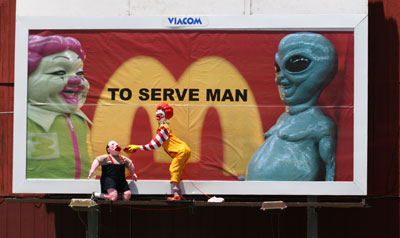
Billboards: a very dated form of advertising. But, surprisingly enough, billboards are still present all over the country. These huge signs are usually located on highways and freeways, which raises some questions about what the advertisers are thinking. I notice one fault in their reasoning. Basically, their idea progression is as follows: If people notice our sign, they will be interested in our product/service; if they are interested in our product/service, they will be more likely to purchase our product/service; therefore, if people notice our sign, they will be more likely to purchase our product/service. In this sense, all the advertisers have to do is create a sign that gets enough attention to make people notice it. That's why billboards are so eye-catching. But the flaw in reasoning is this: will the billboard, once noticed, actually make any impression on a person. I think it wouldn't. People are supposed to pay attention to the road when driving, especially on a freeway. So advertisers are already creating a faulty campaign. But we only really absorb five to ten media messages a day, so for the most part there is also a flaw in the first part of the syllogism. Even if people notice the sign, it may not stay with them.
All types of advertising techniques are used on billboards. But mainly, only one technique is focused on to transfer a message quickly (you're on the road, for heaven's sake). Facts and figures can be used with a big number, or statistic jumping out at you.Gestalt with odd, intense colors, or a questionable image. Perhaps testimonial is used with a recognizable celebrity. Either way, billboards can't be too complex. You only see them for a fraction of a second, and don't have time to decipher them.
For the most part, I think we should do away with billboards. They are a potential distraction, and are becoming meaningless with the introduction of more-effective forms of advertising. They don't put people to work, they are an eyesore, they are gradually taking up more and more space. So why don't we do ourselves a favor and just get rid of them. Well, maybe not. I'm am completely against corporations and large companies using them to their benefit. I could, however, support the use of billboards by small businesses, to help them gain traction in a cut-throat economy. People on the road should be aware of local businesses, so they have a better chance to support them if needed. But already-thriving conglomerates? I don't think so.
Post 11: The Death of MySpace and Development of the Social Network

It really makes sense that Myspace bit the dust this decade. With the introduction of the Apple company and its avante garde products, modern society has been fixated on aesthetic simplicity - Zen Buddhism mixed with above-the-bar technology. Myspace was anything but that. Everything was very cluttered; the greater degree of freedom gave people the freedom to mess up their pages. It was also more suited to meeting new people, when what our society needed was something to bring together everyone we already know. Facebook brought visual simplicity, as well as the simplicity to communicate with people. Part of a new generation of technology, Facebook has integrated itself into the axis of internet power, which includes Google, YouTube, Twitter, PayPal, Tumblr, etc. (all of which embrace the simple aesthetic design. Sure, go onto Myspace now and you'll see a very harmonic display of images, but they fell behind and were easily replaced by Facebook, the new generation of social networking.
In reality, though, all social networking sites appeal to the same things. They know that emotionally, we want to have that instantaneous connection to others; if we do not, we can feel alone. They focus on the Need for Affiliation (the network), the Need for Prominence (the "friend count"), the Need for Attention (the personal page), and the elusive Need for Aesthetic Sensations (the social network site is simplistic programing at its best; we understand the beauty of the site, and want to be a part of it). The biggest technique they use to reel you in is repetition. To gain notoriety, these sites weasel their way into every corner of the web, until you can tie back every page you visit to Facebook, Blogger, or Digg (I still have no idea what Digg is). It's such a shame. Well, I'm signing off now, so I'll probably watch some YouTube videos and link my blog to Facebook. Thank goodness for the simple designs.
Tuesday, May 29, 2012
Post 10: Mitt Shyamalan (M. Night Romney)
The Onion News Network jokingly calls it War for the White House. It's tongue-in-cheek, but is coming closer and closer to reality. Video and television campaigns sponsored by presidential candidates are more of a competition of whose video can slander the opponent the most. This particular ad in support of Mitt Romney does provide facts about Obama's faults, but it is the production of the video that really drives his point home. At the beginning of the video, Obama is giving a speech in Denver; strangely enough, I wasn't paying attention to what he was saying. This is because in the background, the cinematic music overshadows everything he says. Imagine every shocking movie trailer (M. Night Shyamalan especially) - the thundering drums, the slowly-rising synthetic sound that chills your spine and forces you to anticipate a horrible climax, the fast-paced percussion after the climactic point. All of these are better suited to the unsuccessful film The Happening than a Mitt Romney support ad.
At one point, I went back and listened only for what Mr. Obama had to say. What I heard was astonishingly positive. He talks about democrats having a different view of progress, that they "measure progress by how many people can find a job that pays the mortgage. Whether you can put a little extra money away at the end of each month so you can someday watch your child receive her college diploma." What about this relates to chaotic tension that one would find in a thrilling film? I understand that Romney and his staff are trying to show that Obama is not living up to his promises, but the music is more fit for the actual facts than what Obama promised. In general, the ad is really trying to pose Obama as a tyrant, an antagonist, a deceiver. There is a bit of transfer/association used by showing images of North Carolina, probably to make residents feel sentimental towards their state. The images are coupled with the gestalt of rapid motion and frame changes, creating unanswered questions, like "what happens next?" or "what can we do to stop this bad man?" The writers assume you can make the connection between cinematic cliches and politics, but the message is a bit lost.
After the rising action, the ad tries to win the audience over with some facts and figures regarding Obama's failure to make his promises, specifically in North Carolina. It mentions that N.C. is where Obama and friends will be having their next meeting; the ad is most likely directed towards voters in that state. The ad makes a case that Obama has wronged North Carolina, with facts showing the state's bad conditions. But like in every other political ad, there is no evidence to show that Obama is the cause of these bad trends. It could very well be fallout from Bush's ineffective presidency; there is no way to tell with no information.
The final message on the screen is OBAMA ISN'T WORKING.COM; below that are the words "Paid for by Romney for President, Inc." I'm sorry Romney, but if you are trying to appeal the working class, one of the worst things you could do is make your campaign into a corporation. And what's with the 19th century image of people waiting behind an unemployment sign? I don't care whether Grover Cleveland's citizens were unemployed; I would much rather talk about the present. In addition, your color scheme needs work. If you're going for "American," the country wants red, white, and blue, not red, grey, and aquamarine. Just a few suggestions.
Post 9: And Now for Some Music
Very rarely has a short music video gotten an emotional reaction out of me. Cage the Elephant's video for their song "Aberdeen" is an exception. I started listening to this song on the radio a while ago; it really caught my attention and I was instantly drawn to it. The thing that reeled me in the most were the vocals; namely, the emotional and hesitant way they were sung. In practically 99% of professional songs and music videos, the vocals are perfected so that there is no fault or error. Lead singer Matt Shultz contradicts this trend with his many emotional pauses and stutters, giving the song a genuine quality that evokes sympathy from the listener. The vocals are supplemented by a major chord progression that transitions into a darker, minor bridge (in other words, the song goes from innocent to dark through the tone of the music). I probably would have liked the song regardless of the vocal quality, but it made the song much more unique and heartfelt.
As for the lyrics, they are pretty hard to dissect. What I was getting while listening to this song was that the writer is coming to terms with his bad qualities. He is aware of some sort of sinful behavior, but is caught in it and can't escape. This idea is reverberated in the lyrics "Never saw my dark side," and "Saw the flame tasted sin." The "flame" leads me to believe that it could be his drug use/abuse. And the lines "I've been tryin' real hard / To realize / But somethings take a long long / Long long time"give me the feeling that it's something he's been doing for a while, but has not yet realized that it's bad. Now, after doing a little research, I found out that the name "Aberdeen" may refer to Kurt Cobain's home town in Washington. That puts a bit of a spin on things, as now the lyrics could be from Cobain's point of view, lamenting on his own drug use (that eventually led to his death). The town of Aberdeen could have led to his turn to drugs. Or perhaps (and I'm going out on a limb with this one), the song is referring to the writer's admiration of Cobain, also leading to sinful behavior.
On to the video--my favorite part. The song itself got me shivering a bit from the emotional tone. But the music video really put me over the edge. I mean, it's really sad. The entire video is a claymation (more playdough, to be precise), stop-motion video about a large monster and his interactions with people. It becomes evident that all the monster wants to do is become friends with the humans, as he has no friends of his own. But all of this turns for the worst when the clumsy monster accidentally kills a few humans due to its size and strength. The playdough and bright dragon character give the feeling of innocence, but there is also violence and clay gore, giving an air of black comedy that unsettled me. At the end, the army of clay humans fires missiles upon the monster, violently ripping it apart. In the final scene, the commander looks at a sculpture the dragon made depicting its intended friendship with humans. The whole idea of the video is that the subject is misunderstood as this destructive monster, but is actually seeking friendship and compassion. This relates to the lyrics in a way; the writer is misunderstood because of his sinful actions, which are all anyone sees. In reality, he is innocent, and is just being badly affected by an addiction or temptation. Paired with the child-like animation, the message had huge sentimental quality; I felt more sympathy for a playdough dragon than any other character I've seen in a while.
Essentially, the fact that the alternative genre is circulated mostly through the radio and iTunes shows that this song is directed towards young people who already listen to stations that feature their music. The jarring vocal characteristics and video caught my attention, and are meant to do just so. I would vouch that this song exemplifies gestalt, simply because of the vocal pauses and stutters that are unusual because they are not common in mainstream music. But overall, I just really love this song. It is a breath of fresh air from those heavily-altered songs that top the charts today; the singer gives the feeling that he really cares about what he is singing, or that he really is the character he is truing to portray. In fact, a lot of Cage the Elephant's music is very unique and worth listening to. I urge you to check them out.
Tuesday, May 22, 2012
Post 8: The Other Black and Yellow

It's a powerful idea. Practically trademark a color scheme. Make it your own. Advertise it to both athletes and activists. And, most importantly, get a multimillion dollar conglomerate on board. Millions of people have purchased Livestrong (Lance's trademark) products. That is a significant amount of money going towards the foundation. People that would normally not donate money are doing so through their interest in athletic performance and color-coordination. This sort of cooperation is a perfect plan to get more support for important foundations. The way I see it, Nike has way too much money. And if they are not going to pay their overseas workers any more for production, they should at least give away some of their profit. I think every color scheme should have a foundation attached to it. Not only would the previous consumers be giving money, but the people who were too guilty about buying Nike products would be more likely to buy the product to support the cause as well. It's a win-win situation. And it is making lives better.
The moral of this partnership is: learn from Lance Armstrong. True, Nike is doing a bit of good, but it is the actions of this athlete that really matter. He took his battle with cancer and turned it into a cause. To overcome hardship is one thing; to work hard to help others overcome their own hardship is another, more admirable thing. If we want to progress as a society, we must remain focused on the issues of everyone.
Post 7: Panda Cheese
Watch any one of the Panda cheese commercials, and you'll see a few sad-looking people declining an offer for the cheese. Then enters a sweet-looking panda. He is still and proceeds to stare at the person/people who would not take the cheese. This gets very creepy, very fast. The camera angle switches from the cute panda's face to its whole body, which slouches menacingly over the victim. His short, stout body resembles a hulking, angry human - one who looks like they could really hurt you. After a while, the panda grabs the nearest object and destroys it, either by throwing to the ground or smashing it. In one, he screws up a cook's meal; in another, he rips out a sick man's IV. Clearly, the panda does not mess around. One advertising technique Panda uses is Wit and Humor - some may watch the commercials and laugh at the cruel acts of the Panda. For me, on the other hand, it was completely a frontal Gestalt attack. The slow, romantic music in the background is unusual compared to the disturbing footage of a panda threatening innocent people. The threat itself did not sell the product for me. The commercial made a lasting impression in my mind, and now I am very curious as to what the product is like is it has such a strange campaign. The Gestalt aspect raises many questions for me, most prominently: what did I just watch? It's completely an appeal to the need to satisfy curiosity. It could also appeal to the need for safety, because no one wants to be attacked by a panda. Now I really want to try the cheese; too bad I don't live in Egypt.
As for assumptions, these commercials make a few: men are more likely to buy cheese/use it; people like pandas, therefore a menacing panda will be a contradiction; people who do not enjoy a quality cheese like Panda are boring (lifestyles depicted were drab and depressing). A fallacy in reasoning was Begging the Question - you should buy Panda cheese because nobody says no to Panda cheese. Another could be a minor, comical Slippery Slope fallacy - if you do not buy Panda cheese, you will be hunted down by a Panda (and even killed, as suggested in the hospital scene).
Overall, the bizarre commercial caught my attention and now is a topic of humor for me. Sometimes I see potential applications of the Panda scene in real life. Most of all, I want to find this Panda cheese and see what it's all about. And I'm not just saying that to appease this Panda staring over my shoulder. Go and buy Panda, cheese guys! Seriously, you need to! Please Help Me, someone get he----
Subscribe to:
Posts (Atom)